
I must admit that, from a technical point of view, “the internet” often still is a great mystery to me. While the use of media that rely on the internet, such as smartphones, laptops, TVs, etc., is intuitive and presents no problems for my generation, it sometimes seems to me that the actual technical processes and functions of these devices are hidden in a sphere that is invisible to me, and deliberately so.
Long gone are the days when you could open your phone and take out the battery when the device was acting up, and, like a surgeon, get a concrete insight into the guts and layers of the phone.

The more we deal with the phenomenon of „the internet“ during this seminar, the more visible the structures that make it up became to me.
Infrastructures, I read the other day, are both things and relationships. They are technical, but also symbolic, and influence how we think about the everyday technologies we use.
For example, almost everyone now uses some kind of public cloud system to store their photos and files. Gone are the days of insufficient physical storage space on cell phones or computers, because you can simply buy and add new storage space in seconds.
In our imagination, in mine too, the places where our data is stored are often miraculously metaphysical, invisible “clouds” hovering omnisciently above us, independent of any geographical locations on Earth.
Many media represent how the infrastructures of the internet operate on these level of fantasy and desire, turning them into symbols of modernity, the future, and progress, while at the same time playing on the naivety and imagination of people who paint futuristic idylls of storage locations.
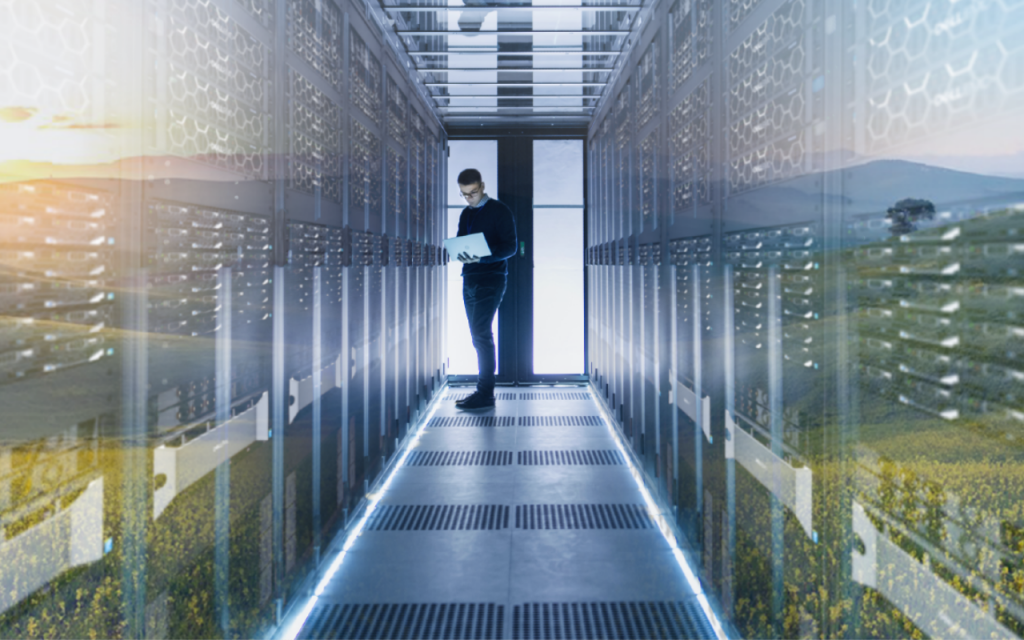
Through the human desire for representation, these infrastructures thus become poetic symbols.
In a world where “transparency” has become as big a box office hit (just as as the term “sustainable”) the functioning of data centers is however still quite opaque.
On the one hand, we hardly imagine them physically, even though they are ultimately just as much hardware storage locations as they used to be in our own devices, only outsourced to third parties.
On the other hand, it is also important not to ignore the fact that infrastructures are not only technical, but also involve material, organizational, and relational issues.
Because not only do the technical aspects often remain hidden, but so do the economic, legal, and political consequences of information infrastructures for the free flow of data around the world. The original “end-to-end” principle of the internet is thus increasingly fading into the background.
Another factor is that companies that sell devices and technologies or rent rack space in data centers need to market and advertise themselves in the best possible way and represent the company positively. A good example is this video from Meta, which aims to explain how their data centers work:
https://datacenters.atmeta.com/what-is-a-data-center
There again is little explanation here of the actual technology behind the “cool servers and cables,” but rather of the positive impact Meta has on “local communities” by building the centers. Yeah, what?
In any case, there is no mention here of the enormous challenge of cooling down data centers of this size and the corresponding use of resources such as water, as well as other environmental issues.
Visualising and imaging the internet’s infrastructure thus remains a challenge – on both ends.
As questions around data security have recently become more pressing and common around users, a more realistic idea of how things actually work is of importance.
I believe that this involves both provider’s willingness to communicate their structures more transparently and comprehensive, but also user’s will to actually deal with and learn about technology and its implications. Overcoming this “fear” of the space and depths behind our screens is therefore a crucial step for our societies to keep our agency in this digital age.
Sources:
- Holt, Jennifer, and Patrick Vonderau. “‘Where the Internet Lives’: Data Centers as Cloud Infrastructure.” In Signal Traffic: Critical Studies of Media Infrastructures, edited by Lisa Parks and Nicole Starosielski, 71–93. University of Illinois Press, 2015. http://www.jstor.org/stable/10.5406/j.ctt155jmd9.7.
- Larkin, Brian. “The Politics and Poetics of Infrastructure.” Annual Review of Anthropology 42 (2013): 327–43. http://www.jstor.org/stable/43049305.
- https://datacenters.atmeta.com/what-is-a-data-center/


I totally agree with you, it’s about time that we make the effort to understand the impact of our digital age, and even make changes upon it. Sadly, many of these companies that take over the digital world will always prefer the consumeristic value rather than the sustainable one, especially since it is usually cheaper for them to be environmentally harmful. But in the end, everything will cost our lives, so to what extent can we let this pass? But also, how can we make such impact that will get these companies to change? I try everyday to keep myself accountable of these things, great that you voiced this!
I’ve never thought about it but it is true, we need to be more educated about the technical infrastructure of the internet and the digital, and what can be the consequences on the planet. We sometimes believe that by making everything digital we will have less impact on the environment, but that’s not true. Everything we do on the internet has an impact, and considering how many people in the world are using it nowadays, the impact is pretty big. We should talk about these things more often, because it’s part of the concept of using the internet with awareness of how it workd and what we do exactly.
I really enjoyes this reflection, it captures that weird contrast between how naturally we use the internet and how little we actually understand the physical systems behind it. I had to look into this for one of my blog posts to and I actually ended writing something quite similar. I really find the concept of the “cloud” very interesting and it still feels like such an ungraspables, almost “magical” thing, even though it’s basically just giant buildings full of servers and cooling systems.
I feel like, as issues like data security and environmental impact grow, i feels more important than ever that both companies and users make the effort to stop hiding what’s really going on behind that cloud.
I really enjoyed how you deconstructed the “fantasy” of the cloud and grounded it in physical infrastructures like cables, buildings and cooling systmes. While reading your blog I noticed that I hardly consider the location of my photos or files, it’s like an abstract infinite space in my mind. This motivated me to be less scared of the technical layer and to actually learn more about what’s happening behind my screen. Thank you!