
In this ever changing world, it is common at times to miss a life that you’ve never got to experience, and for me, this has always been related to anything that had to do with analog technology. When I was 10 I begged my parents for a polaroid camera, and I’ve been using it ever since, and have even upgraded my collection with two different types of film cameras (one 35mm and one 110mm from the 70s). As I got older, I started owning even more analog technology, such as an alarm clock, a record player, and vinyls. In many ways, these devices were a way of wanting to relate to times I never got to experience. As we started working with our podcast session, I started realizing how important different mediums are to shaping a message (thank you McLuhan for your great theory). In this blog, we will be looking more into film photography, and understanding why its current comeback shows a great impact on the message being sent by society.
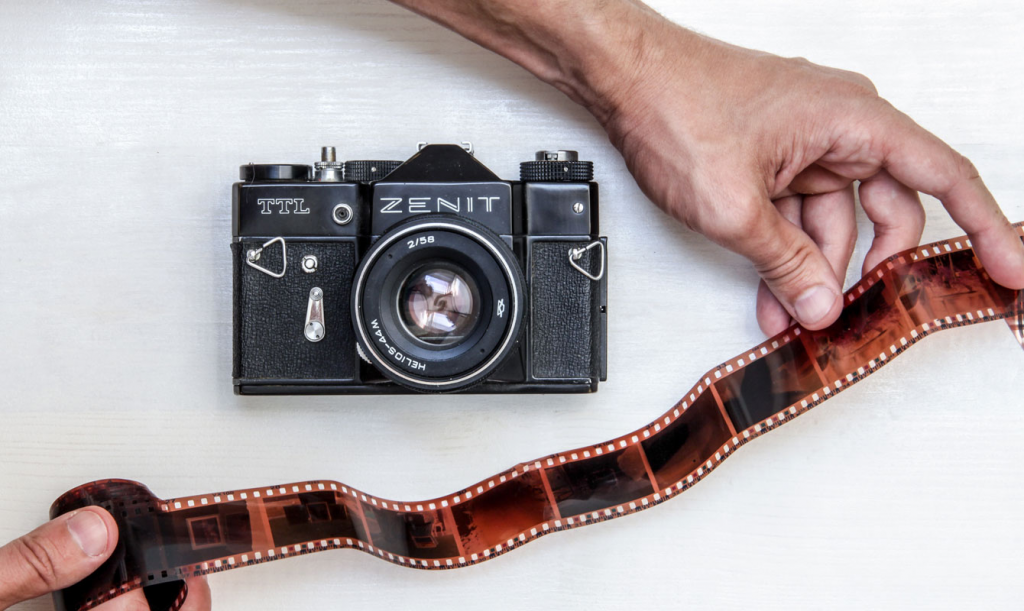
Film Photography’s Revival
Although film photography has always been a medium used persistently in the arts, its use started declining with the creation of digital cameras; people began investing on higher quality images that were also more environmentally friendly than film. My mother never understood my fascination for film cameras, she always asked me “why would you want to take pictures with a film camera where you don’t know what the result will look like? The quality will never compare to a digital one.” I explained to her that it wasn’t about the camera itself, but more about the experience, as well as the image’s aesthetic. In many ways, I believe that this is why this medium began regaining popularity around 2020. This year BBC wrote an article about film photography which stated that “Last year a study from research company Cognitive Market Research said the global film camera market value was set to reach some £303m by 2030, up from £223.2m in 2023.” But why would this rapid consumption connect to 2020? Well, with the rise of COVID-19 and lockdown, many people started looking back at the moments of their past that reminded them of “the good old days”, naming this as “Lockdown Nostalgia”. With this constant search for the nostalgic, people began using film photography as a way of visualizing this feeling; The Wed magazine describes how film’s “rich textures, warm tones, and beautifully imperfect qualities, […] evokes a sense of intimacy that digital often can’t replicate.” Disposable cameras were a staple in the quarantine days, everyone wanted their pictures with friends and daily to be on film.

Shape-shifting photography?
However, how does film photography shape the message? Well, to understand this, we have to go back a bit in time and look at the creation of cameras. Dating back to BC, there are multiple different moments in time that show how humankind has tried to replicate what they saw through their eyes onto a physical object. With the creation of the first camera in 1816, humans have made it their mission to be able to make machines that would replicate the human eye as much as possible. Essentially, the message of a camera has always been to imitate reality, and every version of a camera has most of the times tried to keep this message. This is why, when digital cameras were developed, society turned their way towards the camera whose quality began to imitate reality more clearly. However, by bringing back film cameras, this message changes; people are not in search of higher definitions, something that might uphold a cemara’s main purpose. Society was now in search of a new message in cameras, they started looking at what these cameras could make you feel rather than what they were capable of doing. Something about taking pictures and not knowing if they would appear or not changed the whole meaning of photos for me, I started cherishing moments more often knowing that I might not actually see it in the detail that my phone camera would provide. I would get excited to wait for my pictures to get developed, which this careful process made them feel even more important. I began wanting to take images of moments that I felt deserved to be on film, or of things I believed would look even better if they had that warm nostalgic feeling. It wasn’t about the quality anymore, because if I wanted quality I would’ve bought the latest Canon or the newest phone. The message of these film cameras changed; where once they were a representation of the development of photography, used for their high quality compared to previous inventions; now their “underdeveloped” quality highlights how people are in search for a nostalgic vision rather than the one relating to innovation and quality.
Concluding, it is clear to see that, with the current revival of film photography, society has now brought a new message for cameras and photography. In a world where people search to reconnect with the past and their good memories, cameras have been able to reshape their message to attend to people’s needs.


Once I saw the title of your blog I knew I was going to love it! My family still has a hard time understanding why I like using old cameras when there is so much more advanced technology in the world nowadays. For me it’s not about the quality of the picture but about cherishing the moment and not caring if the picture looks good or not. It’s the only picture of this special moment, so I have to like it either way! With digital mediums we can spend hours and hours trying to get the perfect shot but with film we really only have a few exposures that become really special. There’s been a rise in digital cameras with film camera shells, aiming to make the “film look” more affordable and accessible, which is really interesting and positive. When I first saw it, though, I thought to myself “doesn’t it defeat the entire purpose?” are digital filters enough to create the same feelings? Is it about the look or about the process?
Through your article I really learned some new things about film photography!I especially liked how you connected the pandemic to nostalgia. It reminded me that many technological trends are driven by emotion. During unstable periods, people reach for the feeling of the past, and film provides exactly that visual language. The medium we choose expresses the kind of life we want to live.