Last month, a set of game tutorial videos I uploaded seven years ago received a new comment. It said, “You were part of my childhood. When I first played this game, I learned everything from your videos.”
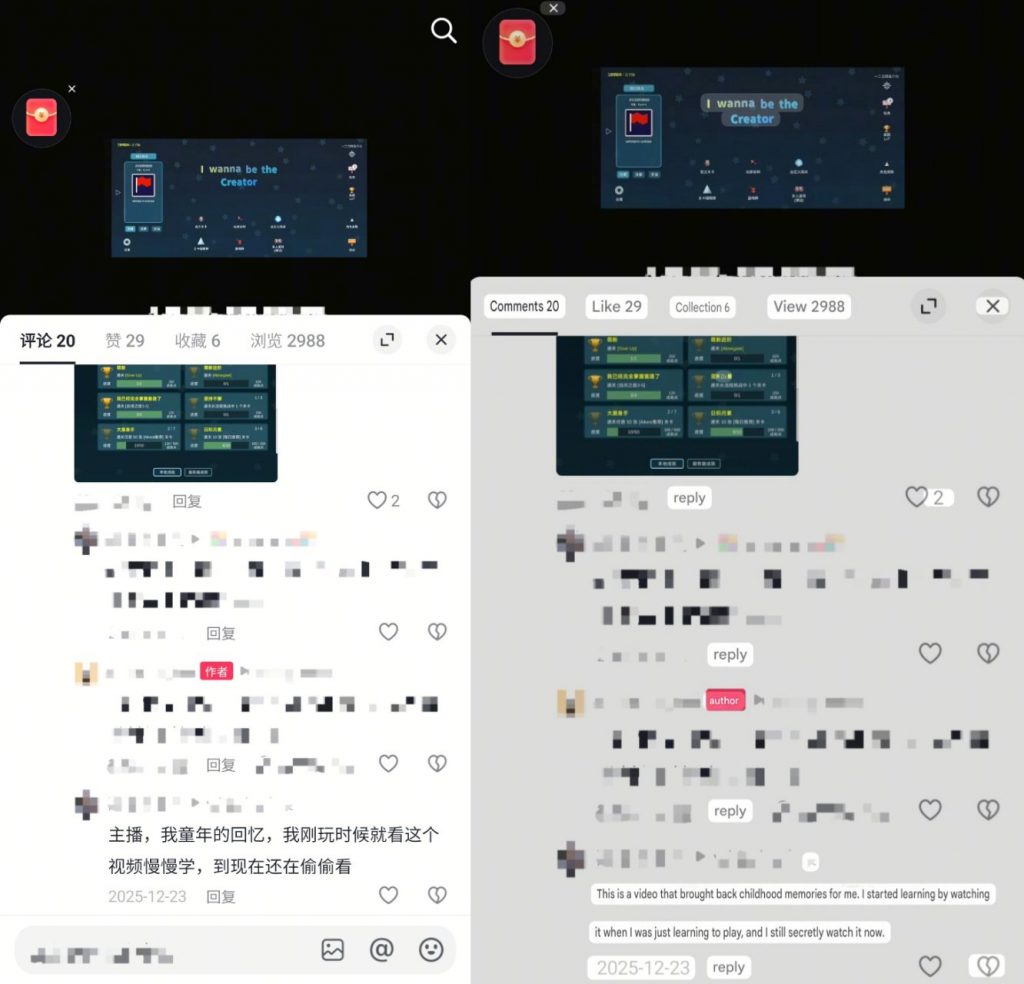
I cannot stop crying when reading it. The game is a very niche platform jumper with poor visuals, no story, and a repetitive design, so very few people played it. I uploaded those videos during a difficult period in my life. I was struggling with mental health issues and hoped that my favorite game could help me reconnect with the world. But because the player base was small, the videos barely received views. So after one month, I stopped updating the account. Seven years later, a stranger told me that those videos once kept them company.
Was this the kind of global connection people imagined when the internet first began?
I started being active on social media after entering middle school, during what many Chinese users call the golden age of the Chinese-language internet in the 2010s. The online atmosphere felt friendlier then, and connections between people felt closer. I used to love a whistling forum where people posted recordings of their work and encouraged one another. I had just started learning to whistle at the time. Whenever I shared my practice pieces, I received encouragement and useful advice. That environment filled me with goodwill toward the online world. I gave part of myself to it. Over the years, I made many friends online. Some came from fan communities, fan fiction writing, and discussions of public events. A few of these friends I eventually met in person. Many others I have never met in real life, even after nearly a decade of friendship.
This was the kind of internet life I longed for. I shared information and received information from others. I shared kindness and received kindness in return. I, along with many others, once imagined a utopian world connected by networks.
But the internet often resembles the real world more than we like to admit. Beneath its bright surface lies a great deal of harm. On most platforms, we are not independent actors. We are crowds carried forward, part of the silent majority. My role is not something I can switch freely. It is pushed in certain directions by platform structure. As a receiver, I am selected by algorithms, fed by recommendations, and shaped by ranking systems. I do not see “the world.” I see a world prepared for me. As a producer, I unconsciously follow platform rules. I learn what kind of content gets seen and what tone earns approval. Even when I disagree with these rules, it is hard to escape them completely. Among mixed information, I am sometimes misled. In heated discourse and competitive content spaces, I sometimes lose both kindness and reason.
That comment after seven years reminded me that outside platform structure, real human connection still exists. It does not rely on algorithms or viral amplification. It simply stays in time and waits to be rediscovered. Sometimes the internet feels like a long echo corridor. A voice we send out may be picked up years later by a stranger.
In an increasingly noisy digital environment, all of us are pulled into it whether we want to be or not. We are both shaped by it and shaping others. One person cannot change the platform structure, but a small trace can still leave a meaning on someone else’s timeline. The internet is not a utopia, but it is not a ruin either. It is constantly used, damaged, and repaired.
At least for the role I choose to play, I still have options.



Recent Comments